The Gray Market Peptide Problem: Why Unregulated Peptides Are Risky
Somewhere between the licensed clinical pathway and outright illegal drug use sits a vast gray market: websites selling peptides labeled "for research use only," shipped in plain vials, to customers who inject them without prescriptions and without any provider involvement. Estimates suggest millions of people in the United States are using peptides this way. It is a practice driven largely by desperation — access problems, cost barriers, and a regulatory environment that, until 2026, had cut off the legal pathway for many popular compounds. But the gray market carries documented risks that go well beyond the compounds themselves. Here's what independent testing has actually found.
What the Gray Market Is (and Why It Grew)
The gray market for peptides is not a single thing. It encompasses domestic and overseas chemical suppliers, online "research compound" vendors, bodybuilding supplement companies selling peptides alongside protein powder, and international pharmacies operating in regulatory environments with little oversight.
The common thread: compounds are sold without prescriptions, without clinical involvement, often without any quality testing, and under the legal cover of labels that say "not for human use" or "research purposes only." These labels don't change the reality of how most customers use the products.
The gray market expanded significantly after the 2023 FDA decision that moved many therapeutic peptides to Category 2, closing the licensed compounding pathway. Patients who had been using these compounds under medical supervision had two choices: stop, or find another source. Many chose the latter. The result was a substantial shift from regulated to unregulated sourcing during the three years before the 2026 reclassification.
What Independent Testing Has Found
The most direct evidence of gray market quality problems comes from analytical testing of commercially available products. The findings are not encouraging.
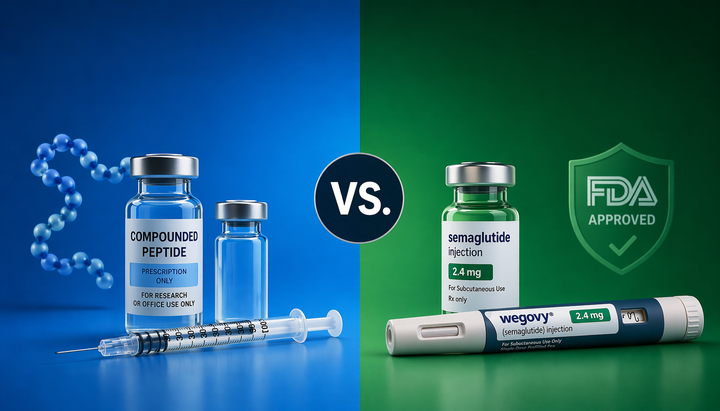
A 2024 study published in Pharmaceutical Research (Hach et al.) analyzed 16 injectable and 8 oral follow-on semaglutide products alongside the originator Ozempic and Rybelsus formulations. The results found new impurities in virtually all follow-on products, including high molecular weight proteins, trace metals, anions, counterions, and residual solvents. Multiple oral follow-on products contained substantially less semaglutide than the label claimed. Fibrillation assays showed some liraglutide follow-on products had increased tendency to form fibrils — protein aggregates that can be immunogenic or toxic.
A 2026 pharmacovigilance study in Expert Opinion on Drug Safety (McCall et al.) analyzed FDA adverse event reports for compounded versus approved GLP-1 products and found compounded products had preparation error rates 48.9 times higher than approved versions, contamination rates 19 times higher, and hospitalization rates 2.35 times higher.
These studies focused on GLP-1 peptides because that is where the largest dataset exists. The manufacturing challenges — producing a sterile injectable product with the correct identity, concentration, and purity — are present for any injectable peptide. For compounds like BPC-157, ipamorelin, or thymosin alpha-1, which are synthesized by chemical manufacturers with no FDA oversight and no pharmaceutical-grade quality requirements, the potential for variation is at least as significant.
The Specific Risks
Contamination with bacteria and endotoxins
Injectable products prepared without proper aseptic technique can be contaminated with live bacteria or bacterial endotoxins — byproducts of bacterial cell walls that cause severe inflammatory reactions even without live bacteria. Endotoxin contamination can cause fever, sepsis-like reactions, and in severe cases organ failure. Sterility testing under USP 797 requirements is designed to prevent this. Gray-market products have no such requirement.
Wrong compound or wrong concentration
Without identity and potency testing, there is no reliable way to know whether a gray-market vial contains what the label says, at the concentration it claims. Receiving the wrong peptide is more dangerous than it sounds: some compounds have opposing biological effects. A patient intending to inject a GH secretagogue who receives an unidentified compound has no way to know what they are administering.
Residual synthesis chemicals
Peptide synthesis involves chemical reagents that must be removed from the final product through purification steps. In properly manufactured pharmaceutical-grade products, residual solvents and synthesis byproducts are tested and must fall below established safety limits. In gray-market products, this purification may be incomplete or untested.
No adverse event reporting or recall mechanism
When a contaminated batch of a licensed pharmaceutical is identified, there is a regulatory infrastructure to issue recalls and notify patients. When a gray-market vendor ships contaminated product, there is no reporting mechanism, no tracking, and no way to contain the exposure.
The Legal Picture Post-2026
The 2026 reclassification of 14 peptides back to Category 1 reduced the practical justification for gray-market sourcing for the compounds it covered. For most of the peptides that were previously unavailable through legal channels, licensed access is now possible.
However, the gray market has not disappeared. Several factors sustain it:
Five peptides remained in Category 2 after the reclassification, and patients interested in those compounds still have no licensed compounding pathway.
Cost. Licensed clinical care — consultation, labs, pharmacy — costs more than buying compounds directly from an online vendor. For many patients, cost is the primary driver of gray-market use.
Convenience. The gray market requires no provider relationship, no lab appointments, no waiting. For patients with established self-directed protocols, the licensed pathway introduces friction that feels unnecessary to them.
Information asymmetry. Many patients simply don't know the quality difference between pharmaceutical-grade and gray-market products, and gray-market vendors don't advertise the risk.
The FDA's March 2025 Final Guidance on research use only products increased enforcement risk for vendors. Enforcement action against domestic gray-market vendors has increased since 2025, though overseas suppliers remain largely outside the FDA's reach.
If You've Been Using Gray Market Peptides
The realistic answer for many people reading this is that they have been using gray-market compounds, are not experiencing obvious problems, and are wondering whether switching to the licensed pathway is worth it.
A few honest points:
Many people have used gray-market peptides without obvious adverse events. The risks documented in the research are probabilistic, not certain — contaminated batches, wrong concentrations, and quality issues don't affect every product from every vendor. This does not mean the risks don't exist; it means they are not uniformly distributed.
The value of the licensed pathway is not only avoiding bad batches. It is the clinical assessment that identifies whether the therapy is appropriate for you, the lab monitoring that detects adverse changes before they become problems, and the quality assurance that makes the risk profile knowable rather than unknown.
Transitioning from gray-market to clinical use is something a licensed provider can help with. Being transparent about your current protocol allows for a safer transition and better clinical management.
Frequently Asked Questions
Are all gray-market peptides contaminated?
No. The research shows elevated rates of quality problems in unregulated products compared to pharmaceutical-grade ones — not that all gray-market products are contaminated. The risk is probabilistic. But because there is no testing or quality control, there is no reliable way to know whether a specific product is safe.
Is it illegal to buy peptides from gray-market vendors?
Gray-market peptide vendors operate in a complicated legal space. The FDA's position is that products marketed for human use without approval are illegal. Enforcement has focused primarily on vendors rather than individual purchasers, but the legal situation for buyers is not straightforward.
How can I tell if a peptide I'm already using is pharmaceutical-grade?
If you received it without a prescription from a licensed provider, and it did not come from a licensed compounding pharmacy with your name on the label, it is not pharmaceutical-grade by definition.
Can I get pharmaceutical-grade peptides more affordably?
Telehealth peptide clinics have reduced the cost of accessing licensed care compared to in-person concierge medicine. Consultation fees, pharmacy costs, and lab costs vary, but the overall expense is not dramatically higher than gray-market use when the full picture is considered.
What should I do if I think I've had an adverse reaction to a gray-market peptide?
Seek medical attention for any significant adverse reaction. You can report adverse events associated with any product — regulated or not — through MedWatch, the FDA's safety reporting portal.
Sources
- Hach M, et al. Impact of Manufacturing Process and Compounding on Properties and Quality of Follow-On GLP-1 Polypeptide Drugs. *Pharmaceutical Research.* 2024;41(10):1991-2014.
- McCall KL, et al. Safety analysis of compounded GLP-1 receptor agonists. *Expert Opinion on Drug Safety.* 2026;25(3):581-588.
- U.S. Food & Drug Administration. Research Use Only Products: Final Guidance. March 2025. FDA.gov
- Rajagopal K, Venkatesan S. Immediate Use Compounding Sterile Products. *Int J Pharm Compd.* 2025;29(5):337-343.
- U.S. Food & Drug Administration. MedWatch Safety Reporting. FDA.gov
This content is for educational purposes only and does not constitute medical advice. Peptide therapies should only be pursued under the supervision of a licensed healthcare provider. Amino Clinic recommends consulting with your physician before starting any new therapy.