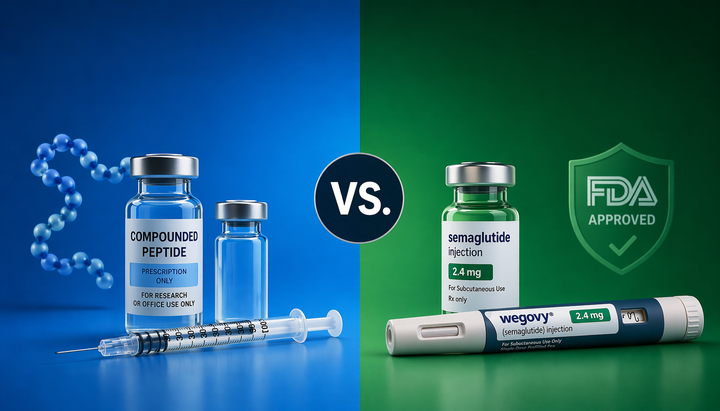
What Is Peptide Therapy? A Complete Guide for 2026

Peptide therapy is one of the fastest-growing areas of personalized medicine. Searches for peptide-related terms in the United States now exceed 10 million per month, and the patient population exploring these treatments extends far beyond the early adopter crowd. But most of the available content is either written for specialists or skewed toward fitness and bodybuilding use cases. This is the guide for everyone else — the person who heard about peptides from a friend, a podcast, or a news article, and wants to understand what they actually are before deciding whether to look further.
What Is a Peptide?
A peptide is a short chain of amino acids — the same building blocks that make up proteins. Proteins are long, complex chains; peptides are shorter, typically fewer than 50 amino acids. Your body produces thousands of peptides naturally, and many of them serve as signaling molecules: they carry messages between cells, regulate hormones, control immune responses, and direct tissue repair.
When researchers and clinicians talk about peptide therapy, they're referring to the use of specific synthetic or naturally derived peptides — either identical to ones your body makes or closely related to them — to produce targeted biological effects.
How Does Peptide Therapy Work?
Each therapeutic peptide works through a specific biological mechanism. There is no single answer that covers the whole category, because peptides are defined by their structure, not their function. But the most clinically relevant ones work in a few main ways:
Stimulating your body's own hormone production. Growth hormone secretagogues like ipamorelin and sermorelin bind to receptors in the pituitary gland and prompt it to release growth hormone. This is distinct from taking synthetic growth hormone directly — the pituitary's natural regulatory mechanisms remain in place, limiting the response to physiological ranges.
Supporting tissue repair and reducing inflammation. Peptides like BPC-157 and thymosin beta-4 (TB-500) influence growth factor signaling, angiogenesis (the formation of new blood vessels), and inflammatory pathways. In preclinical models, they've shown consistent effects on accelerating healing in muscle, tendon, ligament, and gut tissue.
Modulating immune function. Thymosin alpha-1 acts on T-cells and dendritic cells to support immune system activity. It has been used clinically for immune deficiency and studied for its potential in aging-related immune decline.
Improving metabolic function. GLP-1 receptor agonists — the class that includes semaglutide and tirzepatide — mimic a naturally occurring gut hormone that regulates appetite, blood sugar, and satiety. They are the most extensively studied peptide therapies in human medicine.
Skin, hair, and connective tissue. GHK-Cu (copper peptide) influences collagen synthesis and wound healing. It is widely used in topical skincare and, in injectable form, is prescribed for skin regeneration and hair restoration.
What Conditions Is Peptide Therapy Used For?
The honest answer is that the evidence base varies considerably by compound and application. Some uses are well-supported by clinical trial data. Others are based primarily on preclinical research or observational clinical experience.
Well-supported applications with FDA-approved products:
- Weight management and obesity — semaglutide and tirzepatide have extensive phase 3 trial data
- Type 2 diabetes — GLP-1 receptor agonists are first-line treatments
- HIV-related metabolic disease — tesamorelin is approved for lipodystrophy
Clinically used applications with growing but not yet definitive human evidence:
- Recovery from musculoskeletal injury — BPC-157, TB-500
- Age-related growth hormone decline — growth hormone secretagogues
- Immune support — thymosin alpha-1
- Gut health conditions — BPC-157, KPV, larazotide
- Cognitive support — selank, semax (primarily Russian clinical data)
- Skin and hair restoration — GHK-Cu
The distinction matters. A provider can help you understand where the evidence stands for the specific application you're considering, and what the realistic expectations are.
Who Is Peptide Therapy For?
Peptide therapy is not one treatment — it's a category of treatments, each with its own patient profile. That said, some common threads run through the patient population that tends to benefit.
Adults managing age-related decline. Growth hormone secretagogues are most commonly used by adults in their 40s and older who are experiencing the natural decline in growth hormone pulsatility that comes with aging — affecting sleep, body composition, recovery, and energy. The goal is support within physiological ranges, not supraphysiological enhancement.
People dealing with injury or post-surgical recovery. BPC-157 and TB-500 are frequently considered for patients with chronic tendon or ligament issues, post-surgical healing, or persistent gut problems that haven't resolved with conventional approaches.
Patients with immune concerns. Thymosin alpha-1 has a track record of clinical use for immune deficiency and is increasingly discussed in the context of aging-related immune decline.
People pursuing metabolic and weight management goals. GLP-1 peptides are the most medically mainstream option in this category, with robust evidence and broad clinical use.
Patients interested in skin, hair, and longevity medicine. GHK-Cu, epithalon, and MOTS-c have different evidence bases but share a patient population interested in proactive, personalized health management.
What unites these applications is the personalization element. Peptide therapy at its best is not a one-size-fits-all protocol. It is a clinical assessment followed by a tailored prescription based on your specific health picture.
What Does Starting Peptide Therapy Actually Look Like?
If you work with a licensed provider, the process typically follows a clear sequence.
Consultation. Your provider reviews your health history, current medications, lab work, and goals. This is where contraindications get caught and expectations get calibrated.
Lab work. For most peptide protocols, baseline bloodwork is part of the intake process. For growth hormone secretagogues, this includes IGF-1 levels. For metabolic therapies, blood glucose and metabolic panels are relevant. This gives your provider a baseline to measure against.
Prescription and compounding. Your provider sends a prescription to a licensed 503A compounding pharmacy, which prepares your personalized formulation. You receive the compound with a labeled prescription, directions, and typically instructions on self-administration technique.
Monitoring. Follow-up labs and check-ins are part of responsible clinical practice, particularly in the early weeks of a new protocol.
Adjustment. Protocols are not static. Dose adjustments, compound changes, or cycling on and off are all normal parts of long-term peptide therapy management.
Is Peptide Therapy Right for You?
That depends on what you're trying to address, your health history, and the specific compounds involved. The most useful thing you can do before forming a strong opinion is have a conversation with a licensed provider who can look at your specific situation.
What's clear is that the regulatory environment has changed meaningfully in 2026, expanding legal access to many compounds that were unavailable for the past few years. The science is advancing, the clinical infrastructure is maturing, and the patient population is diversifying well beyond early adopters.
If you've been curious about whether peptide therapy fits into your health picture, now is a reasonable time to explore it through a licensed clinical pathway.
Frequently Asked Questions
How is peptide therapy different from hormone replacement therapy?
Hormone replacement therapy (HRT) directly introduces hormones into the body — estrogen, testosterone, progesterone. Most peptide therapies work indirectly, stimulating your body's own hormone production or influencing cellular signaling rather than replacing hormones. Growth hormone secretagogues, for example, prompt your pituitary to release growth hormone within natural regulatory limits, unlike injected HGH, which bypasses those limits.
Are peptides safe for long-term use?
Long-term safety data varies by compound. GLP-1 receptor agonists have years of real-world data from millions of patients. For most other therapeutic peptides, long-term human data is limited. Responsible clinical use includes monitoring and adjustment over time rather than indefinite unmonitored use.
How long before I notice effects?
This varies by compound and what you're treating. GLP-1 peptides produce measurable appetite effects within days to weeks. Growth hormone secretagogues typically show effects on sleep and recovery within weeks, with body composition changes taking months. BPC-157's tissue repair effects, when they occur, emerge over weeks to months. There are no overnight transformations with peptide therapy.
Do I need to inject peptides?
Most therapeutic peptides are administered by subcutaneous injection, which patients are typically taught to self-administer at home. Some compounds have oral or nasal forms, though injectable administration generally provides better bioavailability. Your provider will recommend the appropriate delivery method for your specific protocol.
Can peptide therapy be combined with other treatments?
Many patients use peptide therapy alongside conventional treatments, HRT, or other wellness protocols. The specifics depend on what compounds are involved and what else you're taking. A provider who knows your full medication list can advise on relevant interactions.
Sources
- Józwiak M, et al. Multifunctionality and Possible Medical Application of the BPC 157 Peptide. *Pharmaceuticals (Basel).* 2025;18(2):185.
- Simonova MA, et al. Aging and Thymosin Alpha-1. *Int J Mol Sci.* 2025;26(23):11470.
- Lim M, et al. Weight Loss With GLP-1 Agonists in Nondiabetic Adults. *Obesity.* 2026.
- Vasireddi N, et al. Emerging Use of BPC-157 in Orthopaedic Sports Medicine. *HSS Journal.* 2025.
- U.S. Food & Drug Administration. FDA-Approved Drug Products. FDA.gov
This content is for educational purposes only and does not constitute medical advice. Peptide therapies should only be pursued under the supervision of a licensed healthcare provider. Amino Clinic recommends consulting with your physician before starting any new therapy.